Friday, July 6, 2012

Eye Colour in Humans – Not Just a One Gene Affair

Eye Colour in Humans – Not Just a One Gene Affair

Contrary to popular belief eye colour in humans is not just controlled by one gene in our DNA. High school biology teaches us about Gregor Mendel and his theories about inheritance patterns and how they relate to human eye colour. Prior to recent studies conducted into the genetics of eye colour it was thought to be a strictly mendelian trait (White and Rabago-Smith). However it is now known to be the product of multiple genes. This theory is used to explain why eye colour does not comply with Mendelian patterns of inheritance. For example blue-eyed parents are able to have brown-eyed children, which should not be possible in a Mendelian model where brown is dominant over blue (which can only occur with homozygous recessive genes and thus they would not be able to pass on the dominant gene to their offspring).  This model using a single gene is unable to explain the spectrum of eye colour and the fact that eye colour in humans shows both incomplete dominance and epistasis (University of Queensland).  This suggests that there is more than one gene that controls eye colour.


The colour of an individual’s eye is determined by the ratio of two pigments in the iris of their eye. These two pigments are called eumelanin (the yellow pigment) and phenomelanin (the black pigment) (White and Rabago-Smith). These pigments, melanin, and are produced in the melanocytes of your eye (Ibid). Blue eyes arise from low levels of melanin and increasing levels produce the rest of the eye colour spectrum (Stanford University). The amount of melanin in the iris also affects eye colour. The more melanin that is present, the darker the apparent colour of the eye as when light enters the eye it is largely absorbed rather than reflected back as colour (White and Rabago-Smith). So people with lighter eyes have less melanin than people with darker shades. Individuals may have red or violet eyes; this is due to a condition called ocular albinism and is caused by mutations in their gene sequence (Ibid). 

 Studies conducted by various institutions including the Institute for Molecular Bioscience at the University of Queensland have shown that there are 16 genes which affect eye colour (Ibid). However most of these genes have only a small effect, the two major genes are HERC2 and OCA2 (Ibid). HERC2 affects the way in which the code of OCA2 is expressed in the DNA sequence because of its position in the DNA (Ibid). Any changes in the sequence of these genes have large impacts on the eye colour of the individual. Changes in the OCA2 gene been shown to account for around 74% of variation in eye colour (Duffy, Montgomery and Chen; White and Rabago-Smith). If both copies of the OCA2 gene are missing it leads to ocular albinism (White and Rabago-Smith). Other genes which effect eye colour include agouti signalling protein, tyrosinase, membrane associated transporter protein, p protein oculocutaneous albinism II and melanocortin 1 receptor (Ibid).


 It is clear from the research that has been conducted in this area that the Mendelian model of inheritance is unable to explain the expression of eye colour in humans. There are multiple genes responsible for melanin production in the eye and the main two are HERC2 and OCA2 (Tyler).

Genetic Testing for Newborn Hearing Loss


Genetic Testing For Newborn Hearing Loss


As modern technology allows rapid progress in the field of genetics, genetic testing for various disorders is becoming increasingly common. One recent development in this area is genetic testing for a form of congenital hearing loss.

Currently, newborn hearing screening programs are in place in many countries to test all infants for hearing abnormalities. However, this in itself does not produce a diagnosis for newborns who fail the tests, and indeed most of them have to wait up to three months before any diagnostic evaluation is started. This is not in the best interests of the child, as evidence shows that “identification and habilitation of deaf infants before six months of age improves language outcomes.” (Schimmenti, et al., 2011)


Almost half of all infants with congenital hearing loss have underlying genetic causes for their condition. It has recently been identified that the most prevalent of these are mutations of the Gap Junction Beta-2 gene (GJB2). (Schimmenti, et al., 2011) GJB2 is responsible for directing the synthesis of Connexin 26, a protein that helps to create gap junctions in the cochlea through which potassium ions can flow, thus having an important role in the homeostatic regulation of potassium in this area. This process is essential for maintaining appropriate levels of potassium in the inner ear and thus preventing the malfunction and damage of cells vital for hearing. Connexion 26 may also play an important role in the maturation of certain cochlear cells. More than 90 mutations of the GJB2 gene have been identified thus far that produce a non-functional Connexin 26 protein and result in congenital hearing loss.  (Palmer & Boudreault)


All of these mutations studied to date are autosomal recessively inherited, however it is known that autosomal dominant mutations also exist. Of the afore-mentioned mutations, the majority exert their effects by deleting base pairs. This changes the sequence of amino acids produced and leads to the manufacture of a misshapen and unstable Connexin 26 protein.

Fortunately, a genetic test for the most common of these base pair deletion mutations has recently been derived. Blood samples can be taken from newborns and the appropriate segment of DNA isolated and amplified through PCR then sequenced using this genetic test to determine if the mutation is present. This test has been experimentally proven to detect the majority of infants with GJB2-related hearing loss amongst those that fail hearing screening tests. (Schimmenti, et al., 2011)

Schimmenti et al. (2011) believe that these genetic testing results could be available before traditional diagnostic testing begins and so would lead to an earlier diagnosis and therefore better speech and learning outcomes for many individuals. It is also anticipated that further genetic testing for many other hearing loss-associated mutations of this gene will become available in the near future. Considering that GJB2-related hearing loss is accountable for the majority of genetic hearing loss (and genetic conditions cause half of all deafness), undertaking genetic testing for mutations in this gene may therefore be very worthwhile. This process would involve taking a small blood sample from newborns who fail the hearing screening tests and analysing it for the presence of a mutated GBJ2 gene.

A Healthy Mind is a Healthy Body

A Healthy Mind is a Healthy Body

The world of genetics has evolved into new heights with the invention of personal genomics. This new technology allows practitioners to gather accurate data about a persons health status, which comes in handy when prescribing medication or preventing disease. Eric Nelson, a writer in the Washington Times, explains how a new company, Navigenics, can help you over come your worst health problems and perhaps even increase your life expectancy. This allows us to ask the question: Is there a definite link between the “mind” and the “body”? Questions like what is personal genomics; how does personal genomics work; and what sorts of benefits come with personal genomics, shall all be answered in this blog.


 So what is personal genomics you might say? Well personal genomics is basically the practice of reading or encrypting genetic codes, which tell us about a person’s life style (Nelson, 2012). By reading a persons genes, practitioners in this field can accurately pin point “faults” or “disorders” occurring in your body’s systems and hopefully can rearrange the persons life style in order to prevent such occurrences (Massachusetts General Hospital, 2008). Examples of changing a persons life style are changing a persons diet, exercising more or changing occupation due to too high stress levels (Nelson, 2012). 


So how does personal genomics work exactly? Well a study is the Massachusetts General Hospital in 2008, indicated that there was a direct link between the mind and body (Massachusetts General Hospital, 2008).  This study looked at a wide range of people, all with different life styles (Massachusetts General Hospital, 2008).  The study looked at the specific genetics codes of each individual and it was found that the people with the bad life styles, (ie: people who did not exercise much, ate the wrong sort of foods and people who had problems with coping with stress), were the ones who illustrated cell inflammation, increased programmed cell death and changes to how the cell deals with free radicals (Massachusetts General Hospital, 2008). It can therefore be concluded that a change in diet, increase in exercise and coping with stress levels all have an impact on the health of your mind and body (Massachusetts General Hospital, 2008).

So what benefits come with personal genomics? Well as stated in the study, a person who is concerned about there health can visit a health professional and get tested for all sorts of diseases and/or problems occurring in there body (Nelson, 2012). This new power of genetics can then be used to either prevent or treat diseases that the person could have (Nelson, 2012). Therefore the link between the mind and body is very important when looking at the overall health of the person (Nelson, 2012).

Inheritance of Male Pattern Baldness

Inheritance of Male Pattern Baldness

What is Male Pattern Baldness (MPB)?

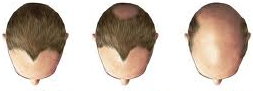
Male pattern baldness (MPB) is a condition which most men (and some women) will face during their lives. MPB causes in people a receding hair line and their hair will become a lot thinner. In the later stages of MPB complete baldness around the crown and possibly the middle section of the top of the head can occur. But what causes male pattern baldness?

What causes MPB?

Testosterone is a steroid hormone that affects many different areas of the body and their functions, however it is not often realized that testosterone is also the cause of hair loss. When testosterone is in the presence of an enzyme called 5-alpha-reductase, the enzyme will break down testosterone into dihydrotestosterone, which is often referred to as DHT.


Male pattern baldness occurs as a result of hair follicles being sensitive to DHT. If a hair follicle is sensitive to DHT it will miniaturize and eventually no hair will grow where that hair follicle grew. It can be seen that through the process of miniaturizing and loss of hair how the symptoms of MPB are so (Receding hair line, thinning of hair). (WebMD 2010)

How does a person’s genetics affect their chance of having MPB?
In 2005, German researches discovered a gene on the X-chromosome that affects baldness (Dr Barry Starr 2006). This gene (androgen-receptor gene, AR) instructs the making of androgen-receptors (also known as dihydrotestosterone receptors).   If the AR gene allows too many androgen-receptors to be made in the scalp or in hair follicles it can result in more testosterone being on the scalp. This in turn results in the creation of more dihydrotestosterone which then leads to greater loss of hair.

Some people who have MPB have an AR gene that performs normally. This means the AR gene is not the only factor that influences the development of MPB. Two independent studies were conducted to discover a common factor that people with MPB had that people without MPB did not have. Both studies came to the conclusion that people suffering with MPB have changes on their chromosome 20 compared to those without MPB.
Everyone has two chromosome 20s, one from each parent. This allows for one chromosome 20 to be unchanged even though the other is changed. This shows that there are three different combinations of chromosome 20s a person can have (and therefore three different likelihoods of having MPB):

1.       Two unchanged chromosome 20s (0 times more likely to develop MPB)
2.       One unchanged and one changed chromosome 20 (3.7 times more likely to develop MPB)
3.       Two changed chromosome 20s (6.1 times more likely to develop MPB)
(Melinda Beck 2008)

Not just one factor affects the likeliness of developing male pattern baldness.  An AR gene that allows for too many androgen-receptors to be in the scalp or hair follicles will increase the chances of developing MPB dramatically. Certain variations to the chromosome 20 also increase the probability of having MPB. Variations on one chromosome 20 will increase the chance of having MPB by 3.7 times and having variations on both chromosome 20s will increase the chance by 6.1 times.

A Cure For Obesity

A Cure For Obesity

Obesity is a major health concern all over the world. It can activate many other diseases including diabetes. Obesity is defined by the increased body weight caused by excessive accumulation of fat and the latest data recorded estimates that there are at least 300 million obese people in the world . Scientific researchers are constantly searching for efficient and effective ways to help reduce the risk of obesity. It wasn’t until recently that new research from the University of California, San Francisco suggested that ordinary fat cells can be reengineered to burn calories.
Image 1: Image of white fat cells.


Image 2: A scanning electron micrograph of
brown fat tissue .


Basically we have two different kinds of fat cells; white fat cells that store excess energy and, accumulate when weight is gained and brown fat cells which oxidize fuels and dissipate energy in the form of heat. Brown fat cells are the main interest, as experiments have shown they have the potential to counteract obesity. However these brown fat cells exist only in large doses in mice and infants. Adult humans do not have distinct brown fat, but they do appear to have small numbers of brown fat cells in white fat. So therefore to reduce the risk of obesity our bodies need to contain a larger amount of brown fat. Recently while investigating how a common drug given to people with diabetes works in mice, the University of California, San Francisco discovered a protein called PRDM16; found in both men and mice, can throw a switch on fat cells converting them from ordinary calorie-storing white fat cells into calorie-burning brown fat cells . This protein, PRDM16 also is encoded by a gene known as the zinc finger transcription factor that mediates protein-to-protein interactions . This protein can therefore assist the body in converting stubborn white fat cells into active brown fat. However to successfully complete this transition, the protein needs to be stabilized by a safe compound that enables PRDM16 to accumulate and activate receptors that induce brown fat cells before the protein breaks down .


Several experiments have been in place over the past few years to test this theory. As mentioned earlier mice contain large amounts of brown fat and therefore made the perfect test subjects. In the laboratory research, obese, male mice aged 3-4 weeks were injected with many types of drugs that had the potential to raise PRDM16 levels and therefore stabilizing the protein to promote the conversion of white fat cells into brown fat cells . One of the most effective drugs proven was the irisin hormone and within 10 days of treatment, the rodents’ blood sugar and insulin levels stabilized; preventing the onset of diabetes and they lost weight .

These experiments have not yet been tested on humans, however given that the mouse and human forms of the protein PRDM16 are quite similar there is a possibility that these same results will occur in humans; therefore will counteract obesity . The irisin hormone however being effective on mice still may have the possibility to prove ineffective on humans and therefore scientists are continually researching new drugs that target PRDM16 protein to raise and stabilize its levels and therefore offering new hope in the fight against obesity.